Why Saying No to Your Dog Isn’t a Bad Thing
My favorite flower is the zinnia. Mostly because they're the only flower I've successfully grown from seed without somehow accidentally killing them halfway through the process.
The first year I planted them, someone told me you're supposed to pinch off the very first flower bud that appears. Something about it creating more blooms later.
And I remember thinking, absolutely not.
Because that first bud was the entire reason I planted them in the first place. That little bud was the payoff. The thing I'd been checking on every morning while standing outside in pajamas holding coffee and pretending I was about two weeks away from starting a small cut-flower business.
And now you want me to cut it off?
No thank you.
So I ignored the advice.
And what I ended up with was six lonely little zinnias in my raised garden bed. One flower per plant. Less magical English garden and more "gas station flowers trying their best."
The next summer, I tried again. And this time I actually followed the advice, fully expecting to regret the decision.
But a few weeks later, half my garden bed exploded with zinnias. Bright pinks, oranges, yellows everywhere. Not six flowers. Hundreds.
And now I actually look forward to pinching them because I understand what comes after.

So many zinnias after pinching!
I think this is how a lot of owners feel about saying no to their dog.
Like it somehow goes against love, when really it's often the thing that finally helps life feel easier for both of you.
Because what I've found after years of working with dogs is that most of them are craving clarity way more than people realize. And a clear "no" is often the thing that finally helps everything else click.
So let's talk about what correcting your dog with an e-collar actually looks like in real life.
Does Correcting Your Dog Hurt Your Relationship?
I think this is one of the biggest fears owners have when they start learning about e-collar training.
If I correct my dog, will they be afraid of me?
Will saying no damage our relationship?
Am I being mean?
But a correction doesn't have to be angry, emotional or scary. It's information.
Fred recently arrived for his board and train. He's bouncing around everywhere, launching himself at me like we're long-lost cousins reuniting at an airport.
Sweet dog. Zero emotional regulation.
I put the e-collar on and start introducing it the same way I always do: tone plus low-level stimulation. Calm and slow.
We're moving around my living room. I tap tone, tap stim, say his name and encourage him to move with me.
We're just building an association:
Feel this, hear this, move this way.
That's all.
And then Fred jumps on me.
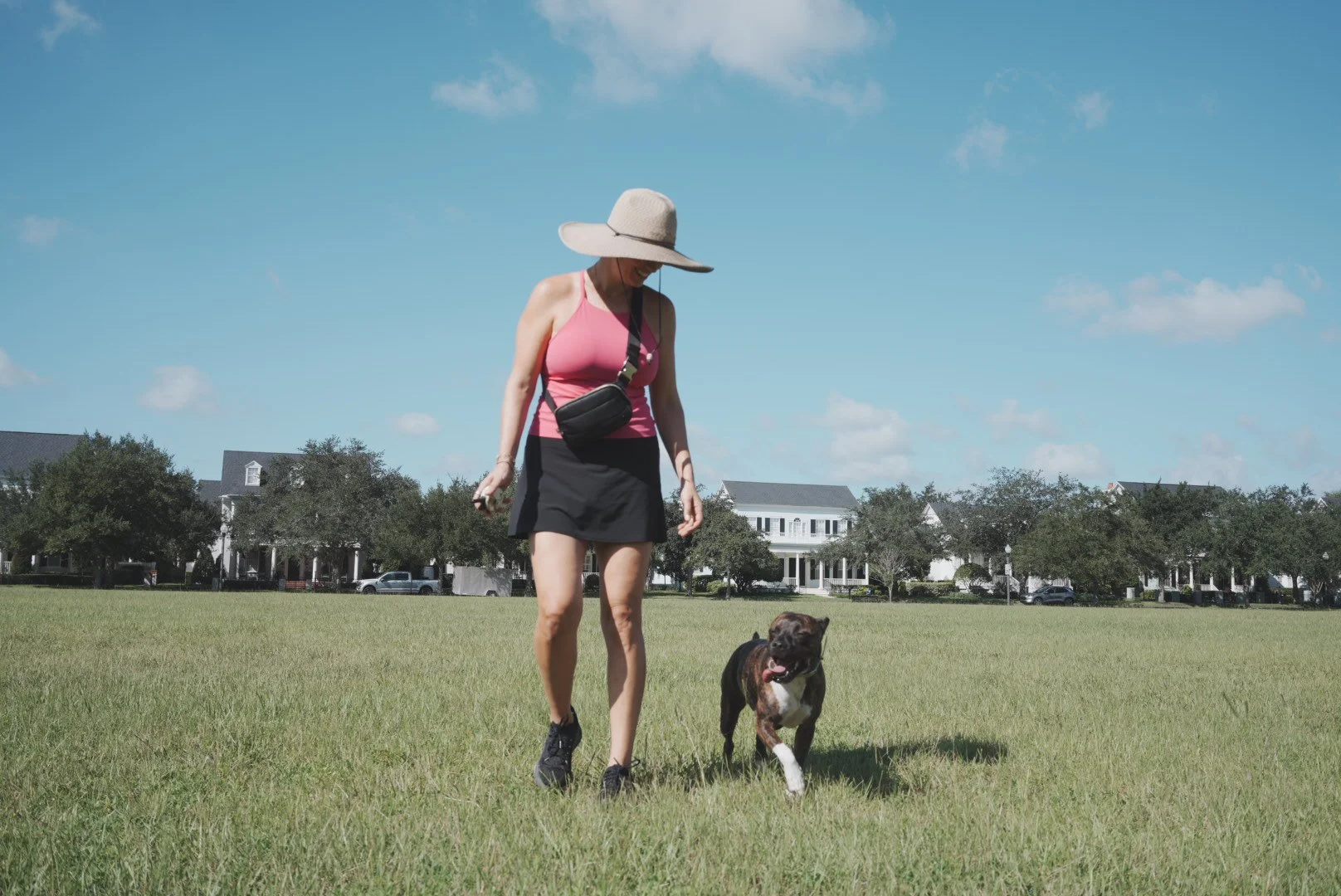
Me with my sweet dog Johnny having some fun off-leash thanks to e collar training.
Using an E-Collar to Correct Unwanted Behavior
Even though we just started working together, I can still use the e-collar to communicate:
No. Not that.
His working level might be an 8, but that doesn't mean an 8 will necessarily interrupt jumping when he's excited. To interrupt the behavior, I may need something more meaningful in that moment. Maybe that's a 25 or 30 depending on the dog. Possibly higher.
The number itself isn't the important part. The individual dog and their response are.
So the second Fred jumps, I calmly say "no" and give one tap.
That's it.
For some dogs, that's enough immediately. Boundary understood. Other dogs need a little more clarity before it clicks.
Either way, the leash helps me immediately redirect afterward.
Don't jump. Do this instead.
And what's interesting is how quickly a lot of dogs change once the conversation becomes clear.
Dogs like Fred stop bouncing around so frantically and actually start looking to you for guidance. It's like all the static finally clears enough for an actual conversation to happen.
Dog Training Corrections Don't Have to Be Scary
Correcting jumping doesn't look like me screaming while a dog shuts down trembling in the corner wondering where the joy went.
That's the picture people sometimes imagine when they hear words like correction or e-collar.
But that picture doesn't reflect how I train.
Everything comes back to how the e-collar is being used and what happens after the correction.
And I know there are some people who will never be okay with e-collar training no matter how calmly or fairly it's explained because the issue isn't actually the tool.
It's that they fundamentally don't want to say no to their dog.
The idea of correcting unwanted behavior feels emotionally wrong. Like boundaries somehow damage the relationship.
But saying no doesn't mean you love your dog less.
A lot of times, it's one of the clearest expressions of love there is.
Dogs Give Each Other Boundaries Too
Dogs understand this way better than we do.
I have four dogs with wildly different personalities, and watching them interact sometimes feels like living inside a very chaotic nature documentary.
Theo—our Rottweiler and pit bull mix—is our confident one. Very sure of himself.
If Johnny—our sweet, submissive Staffordshire terrier mix—gets too close while Theo has a toy, Theo communicates a boundary very clearly by showing his teeth. Sometimes he'll snap at Johnny.
A very clear:
You're too close.
And Johnny immediately responds by looking away and pretending he's disappeared.
His way of basically saying, heard you loud and clear sir, my apologies for existing near your tennis ball.
And then thirty seconds later they're lying together on the floor like nothing even happened.
That's the thing people miss about clear boundaries with dogs:
They don't create drama. They end it.
Once everybody understands the rules, everybody relaxes.
The correction itself isn't what creates tension. The uncertainty does.
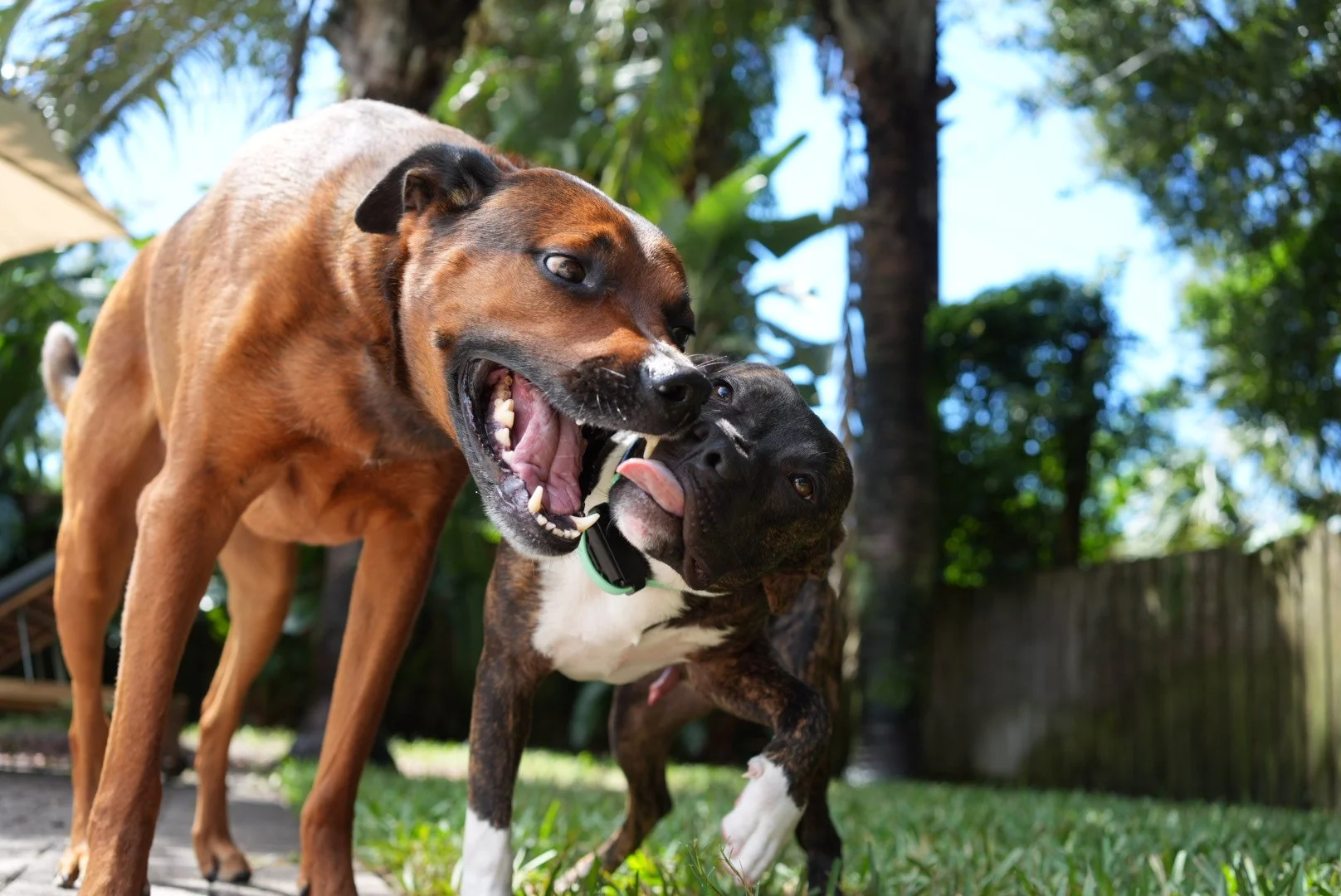
Theo and Johnny :)
Why Clear Communication Matters in Dog Training
Dogs have been correcting each other long before humans entered the chat with treat pouches and complicated opinions about dog training ethics.
Corrections between stable dogs are usually fast, clear, unemotional and over immediately.
Humans just aren't very good at communicating that way naturally.
We can't show our teeth effectively or growl properly.
Well, technically you can, but have you ever tried growling at your dog?
It feels a little less I'm communicating clearly and a little more I should probably spend more time around other humans.
And if you've ever tried talking your dog through a reactive episode using only your voice and a piece of freeze-dried chicken while they're completely locked onto another dog, you already know how frustrating unclear communication can be.
For me, the e-collar helps bridge that gap.
Not through anger or intimidation.
Through clear, immediate information.
And once your "no" finally means something consistently, your dog stops guessing.
What Is the Purpose of an E-Collar in Dog Training?
That's really the e-collar's whole job.
To give you a way to communicate clearly with your dog, even when distractions are high or your voice has become background noise.
It doesn't replace teaching your dog what you do want. It doesn't mean correcting every tiny mistake. And it certainly doesn't mean turning the remote up and hoping for the best.
The e-collar is simply one part of the conversation.
Sometimes it means, yes, keep going.
Sometimes it means, come back to me.
And sometimes it means:
No. Don't do that.
Your dog is allowed to hear that.
You're allowed to have boundaries.
And having clear expectations for your dog doesn't make you a mean owner.
Sometimes saying no is exactly what allows you to say yes to so much more later.
Kind of like cutting that first zinnia bud.
It feels wrong when you're staring at the thing right in front of you.
Until you understand what comes after.
And if you've ever stood in your backyard saying "no" fourteen times while your dog continues doing the exact thing you're saying no to, you already know how much clear communication matters.
By the end of it, you're honestly not sure who's being trained.

Me with training dog, Kyara walking out of my one of my favorite places - the garden center at Home Depot.